
Three proven playground ideas to build community include creating themed play zones that reflect local history, installing versatile seating for intergenerational gathering, and developing multi-age inclusive structures.
These strategic design choices transform standard recess areas into vibrant neighborhood hubs where social connection and safety flourish. Careful planning ensures these spaces serve every member of the neighborhood effectively.
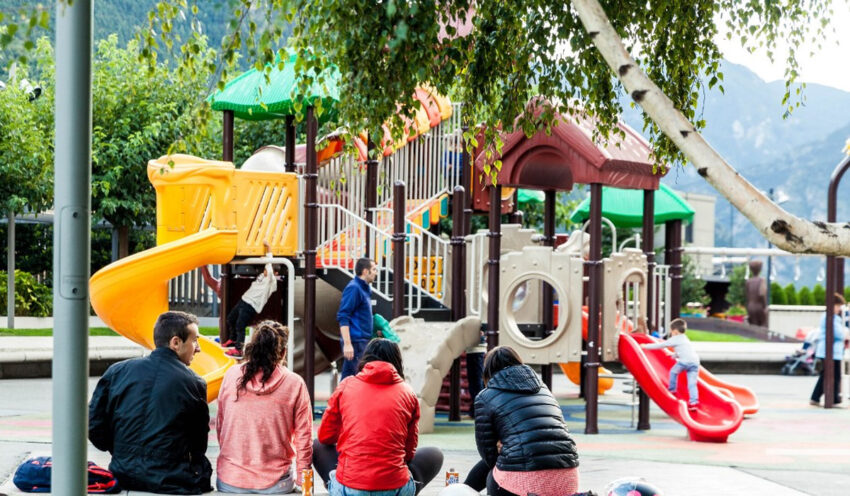
1. Themed Play Zones That Celebrate Local Stories
When children step into a play environment designed around a specific narrative – such as a pirate cove or a woodland village, they instantly feel a sense of ownership over the space.
Shared storylines spark imaginative play and foster neighborhood pride, turning a generic park into a local landmark. This thematic approach encourages children to role-play together, breaking down social barriers.
Bringing these visions to reality requires versatile components. Utilizing resources like inclusive playground equipment from WillyGoat allows planners to select durable, themed elements that match specific local narratives while ensuring the space remains accessible to all children. This helps bridge the gap between creative imagination and necessary structural safety.
Inviting the community into the design process further cements this connection. Schools can engage art classes to sketch murals or color panels, which manufacturers can then precision-cut from durable HDPE materials.
This approach engages multiple senses through bright colors and decreases vandalism, as the community views the playground as a space that truly belongs to them.
Key Insight: Inviting local students to design murals or color panels doesn’t just look good; it creates psychological ownership. When the community views the playground as its own creation, instances of vandalism and graffiti often decrease significantly.
2. Versatile Seating and Gathering Areas for All Ages
A playground that welcomes grandparents, caregivers, and older siblings to linger naturally becomes the neighborhood’s informal meeting place.
A survey of 1,350 adults visiting 60 playgrounds across the USA found that about two-thirds of respondents living within half a mile from the playground reported visiting it at least once per week, compared with 14.1% of respondents living more than a mile away. This data suggests that creating comfortable local hubs drives frequent attendance and strengthens community bonds.
Effective community playground design mixes shaded picnic pods with buddy benches. Small pergolas or tensile shade sails create comfortable environments where parents can supervise without obstruction, which is critical for the safety of children who may need extra support.
Prioritizing sight lines ensures that adults can watch multiple play zones simultaneously, making the space safer for everyone.
Pro Tip: Treat the playground perimeter as an outdoor living room. By installing comfortable seating and shade sails with clear sight lines, you encourage parents and caregivers to stay longer, fostering a safer, more connected neighborhood hub.
3. Multi-Age, Inclusive Structures That Grow With Kids
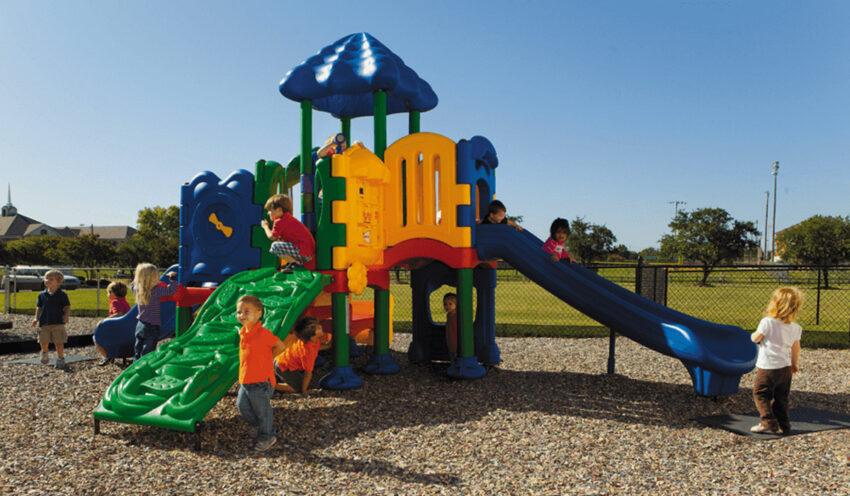
A single connected structure scaled for toddlers through tweens lets children learn from one another and builds empathy while keeping supervision logistics simple. Rather than segregating age groups entirely, a blended approach encourages social-emotional learning. This layout allows families with multiple children to stay in one area comfortably.
Designers can achieve this by connecting graduated challenges. Positioning lower platforms next to net climbs and taller slides allows siblings or friends of different abilities to meet in the middle while staying within their respective skill zones.
Including ground-level sensory play, such as musical drums, spinners, and tactile walls, ensures that children using mobility devices have equal access to the fun alongside their peers.
Safety surfacing is the foundation of this concept. In a study of 95 children aged 4 and above, participants played for an average of 31.8 minutes, were ambulatory for 25.9 minutes, took 1,826 steps, and accumulated 17% of the recommended daily step count during unstructured play on an inclusive community playground.
Quality surfacing, like poured-in-place rubber, facilitates this high level of activity for all children, regardless of mobility.
Getting Your School or Neighborhood Started
Transforming a vision into a physical reality requires a structured approach to planning and execution.
Host a Design Workshop
Invite parents, students, city planners, and occupational therapists to sketch ideas on site maps. Hands-on charrettes often uncover invisible needs – such as the necessity for a quiet sensory retreat nook or a specific drop-off lane – that professionals alone might overlook. Collaboration at this stage prevents costly redesigns later.
Evaluate the Site Thoroughly
Before selecting equipment, assess drainage, natural shade patterns, and street-view visibility. A well-lit, easily accessible playground sees higher after-school use and lower maintenance issues over time. Proper site evaluation ensures the longevity of the investment.
Partner with Certified Installers
Ensure all selected components meet current ASTM and IPEMA standards, particularly regarding fall zones and surfacing thickness. Professional installers can also guide phased construction if budget constraints require the project to be built in stages.
Warning/Important: Never compromise on safety standards. Ensure all equipment and surfacing meet current ASTM and IPEMA regulations. Skipping professional compliance checks to save budget can lead to serious liability issues and compromised child safety.
The Path Forward
Building a playground that truly serves a community goes beyond installing slides and swings. It involves creating a welcoming environment where stories are celebrated, generations connect, and every child finds a place to play. By following these proven ideas, neighborhoods can build lasting legacies of joy and inclusivity.
Author Profile: WillyGoat is the leading online retailer of commercial playground equipment for schools, parks, churches, daycares, and communities across America.